
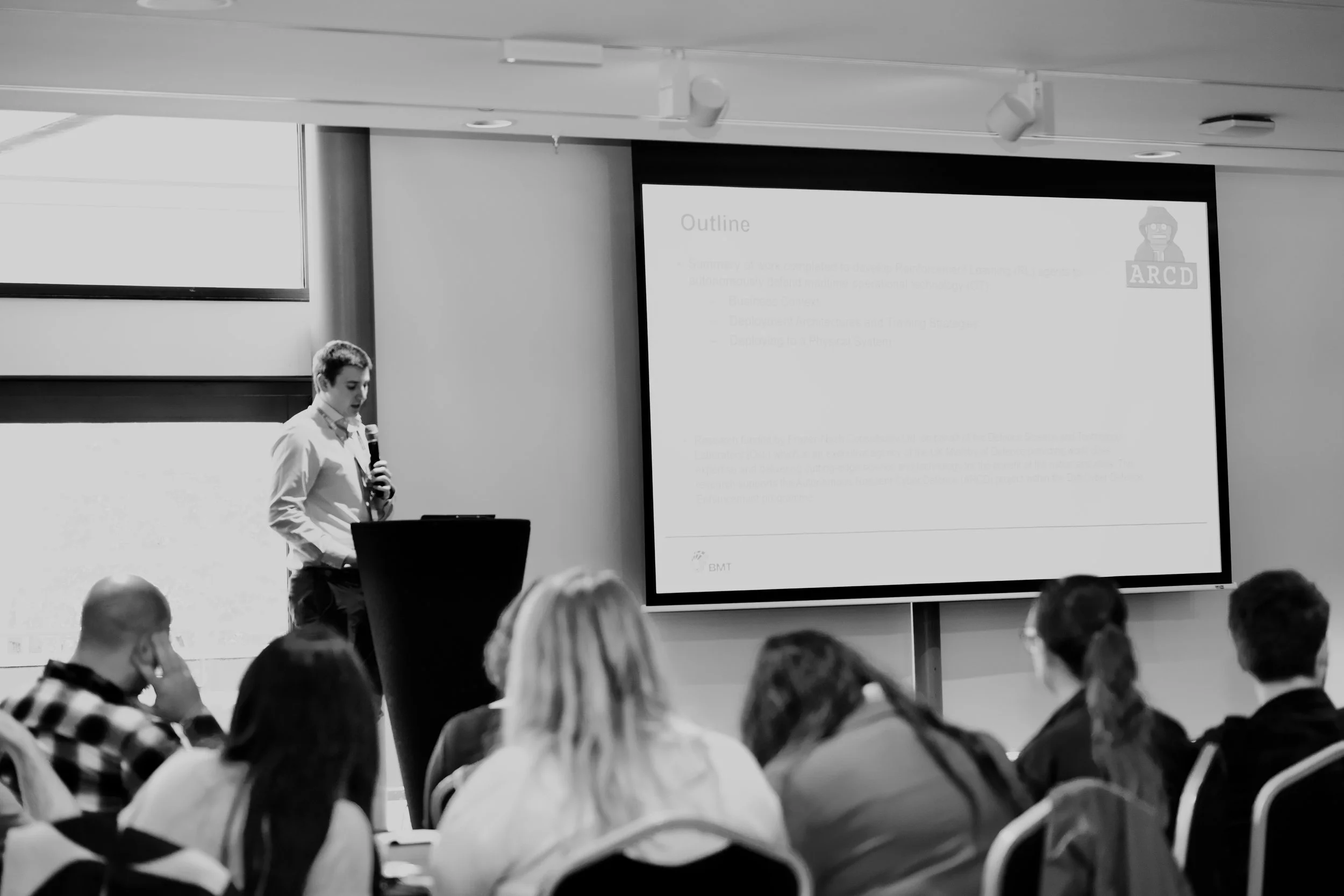
Event Programme
AMLUCS 2026: A Preview of What's Coming
The submissions are in and our reviews are complete! We’ve been overwhelmed by the volume and quality of submissions, and the diverse spread of content from across government, industry and academia.
Please see below the programme for AMLUCS 2026. We look forward to seeing you at UK's leading conference for the practical application of AI and cybersecurity.
Panel Discussions
Where Do We Start? The Difference Between AI Security and Traditional Cyber Security
With AI adoption accelerating, many organisations are still wrestling with where to begin in securing their AI Systems. This panel brings together policy makers, researchers and technology practitioners to discuss practical AI cyber security measures, adoption strategies, success stories, common pitfalls, governance considerations and how to provide measurable value.
Secure Enough? How Regulation Shapes AI Security
As governments and regulators increasingly focus on AI risk and accountability, security teams must understand how regulation impacts both system design and deployment. This panel will explore emerging regulatory approaches, standards, assurance expectations and how organisations can balance innovation with compliance.
Hands-On Workshop
The Agent's Inner Monologue: Catching Compromise in the Reasoning Trace (Secure Agentics)
Most agent defences operate at the edges: input filters, guardrails, output classifiers and system prompts. But what if the most valuable security signal lies inside the agent itself? Inspired by recent advances in monitoring agent reasoning processes, this highly practical workshop explores how observing an agent's reasoning trace can reveal attacks and behaviours that action-level monitoring alone may miss. Gain hands-on experience using Adrian, an open-source agent runtime monitoring platform.
To get the most out of the session attendees require:
A laptop they can install software on, with a terminal, Python 3.12 or newer, git and a modern browser. Easier with Linux & Mac, and Windows users on WSL2.
A free Adrian account, created beforehand at https://app.adrian.secureagentics.ai/login
Meet your trainers:
Max Corbridge, CEO & Cofounder at Secure Agentics.
Max spent 6 years as an ethical hacker, working with some of the largest organisations and governments on the planet. After seeing how organisations were rapidly adopting an insecure technology in AI agents, combined with a research paper from OpenAI & Deepmind exploring a novel approach to monitoring AI systems, he quit his job and started building the first open-source runtime security toolkit in the industry. He is a regular speaker on BBC News on the topic of AI security.

Sunny Chau, Head of Research @ Secure Agentics
Sunny has years of offensive cyber security experience working as a penetration tester and a covert red teamer, having spoken at various security conferences around the world on cloud-native security, identity hacking and all that good stuff. He took his adversarial mind to Secure Agentics as Head of Research, where he leads work on the agentic attack surface, finding the ways autonomous agents get compromised in production, and building the detection logic to catch it.
Pre-Conference Training Course
A 2-day hands-on course for security engineers and AI/ML practitioners (Deep Cyber)
Remember to sign up for our two-day pre-conference course which teaches a working AI red teaming methodology you can apply to production AI systems on Monday morning. Across ten modules, attendees move from the foundations of AI red teaming through hands-on attack execution, multi-turn techniques, methodology, and reporting, finishing with how the evidence produced supports ETSI EN 304 223 conformity assessments [link].