
AMLUCS 2026
Brought to you by:


Platinum Sponsors

Gold Sponsors

Venue Sponsor

Supported by




AMLUCS 2026
🎉What an incredible couple of days at Plexal, Here East, Queen Elizabeth Olympic Park for the fourth annual Applied Machine Learning for Cyber Security (AMLUCS) Conference.
We set out to create an event focused on the practical intersection of AI/ML and cyber security, bringing together the people researching, building, deploying and securing these technologies. ...Look what we've all achieved!
It was fantastic to see that ambition reflected in a sold-out conference and a community spanning central government, defence, major primes, SMEs and academia.
A few highlights:
A near 50/50 audience split across our two tracks, demonstrating the appetite for both Real-World & Applied perspectives and Research & Innovation.
A programme tackling some of the biggest questions facing the community, from agentic AI, autonomous cyber defence and AI security assurance, through to vulnerabilities, regulation, critical infrastructure and the security of the wider AI technology stack.
Talks that went beyond the technology itself, exploring the human element of AI security, including how we integrate autonomous systems with human judgement, oversight and accountability.
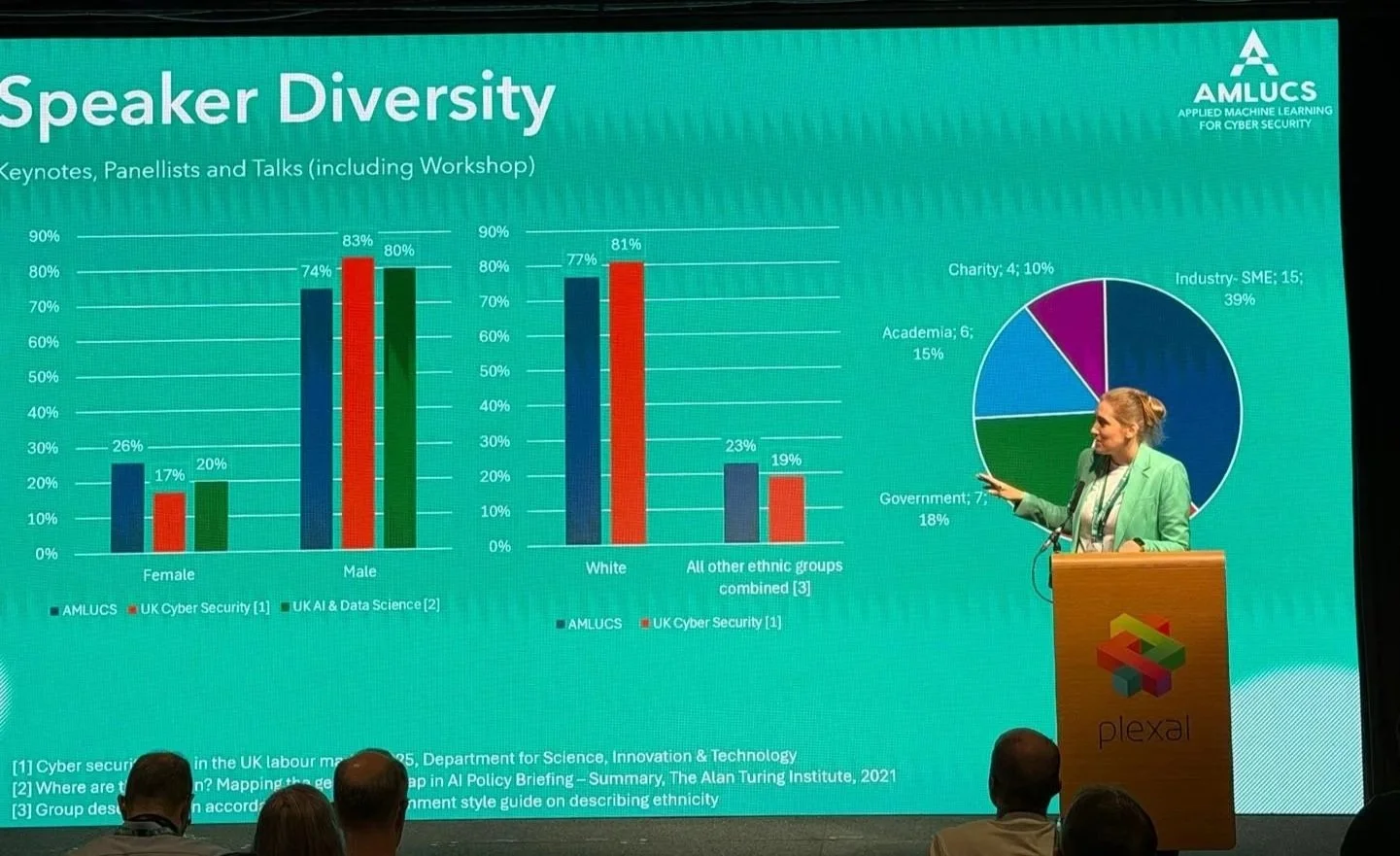
A continued focus on diversity, inclusion and the future pipeline of talent. Through our partnerships and bursary scheme, we were delighted to support early-career practitioners and academics to participate, learn, build their networks and contribute to the community.
But perhaps the biggest highlight was the community feel throughout.
AMLUCS is about bringing together different backgrounds, disciplines, organisations and perspectives, creating an environment where people can ask questions, share knowledge, challenge ideas and learn from one another. Seeing those conversations and new connections happening across government, industry and academia was hugely rewarding.
Selling out the conference was a fantastic milestone, but seeing the community grow, collaborate and share ideas is the real measure of success.
There is a huge amount happening at the intersection of AI and cyber security. The challenge now is to keep those conversations, connections and collaborations going long after the conference doors close.
See you at AMLUCS 2027! 🚀
Day 1
Real-World & Applied Track
Thematic Review and Gap Analysis of AI Security
Edward Austin, Lancaster UniversityPanel: Where Do We Start? The Difference Between AI Security and Traditional Cyber Security
Ed Venmore-Rowland (Head of AI Cyber Security Policy, Department for Culture, Media and Sport)
Harriet Farlow (Founder of Mileva Security Labs, AI Security researcher, author of 'Practical AI Security’)
Dan Jones (Founder of Stealth Agentic AI Security, former Microsoft AI Red Team).Developing and Delivering the Australian Government’s First AI Security Framework Outside of National Security
Harriet Farlow, Mileva Security LabsProtecting the AI from the Human
Heather Taylor, Frazer-Nash ConsultancyReproducing Mythos Findings with Public LLMs & Disclosing Two New Linux Kernel Zero-Days
Klaudia Kloc, Vidoc Security LabThe Agentic Attack Surface: Latent Failures in Autonomous Workflows
Ihsen Alouani, Queen’s University BelfastAutonomous Cyber Agents Meet Critical Infrastructure: Emergent Risks and Capabilities
Chris Hicks, The Alan Turing InstituteIntegrating Agentic AI into a Human Decision Making Team
Heather Taylor, Frazer-Nash ConsultancyResearch & Innovation Track
Detecting Attacks Against AI Systems
Louise Axon, University of OxfordTwo Graders for One Agent
Gilad Cohen, AliceDo Model Representations Know When a Jailbreak is Working?
Sabrina Sadiekh, HiveTraceLatent Backdoors
Katy Harrington, Loughborough UniversityHessian Spectral Signatures for Backdoor Detection
Steven Young, The Alan Turing InstitutePackets as Binary Images: Per-Packet Intrusion Detection for OT
Aamir Omar, BMTCapture the Flag, Miss the Malware: Hijacking Agentic Code Scanners with Planted Rewards
Gilad Cohen, AlicePlanning for Quantum Backed AI
John Sotiropoulos, DeepCyber and Roy Barker, NebiusAgentic Large Language Models for Autonomous Cyber Operations
Gregory Palmer, BAE Systems Digital IntelligenceDay 2
Real-World & Applied Track
Sustainable Cyber Security in the Era of Hyperconnected Agentic AI and Cyber-Physical Systems
Ryan Heartfield, Palo AltoAgentic AI for Cyber Security - An NCSC Perspective
Paul J, NCSCMeasured Feasibility of Agentic Cyber Defence at the Land Tactical Edge
Ian Griffiths, Aeris UKPanel: Secure Enough? How Regulation Shapes AI Security
Ali Shepherd (CISO and Chief Scientific Advisor, FCA),
Dr. Alec Banks (Principal Advisor, Autonomous Systems & AI Safety Engineering, Dstl)
John Sotiropoulos (Founder of DeepCyber, Board Director of the OWASP GenAI Security Project, best selling AI Security author)Investigating Agentic Cybercrime: a Forensic Model, its
Judicial Validation, and a Reference Implementation
John Sotiropoulos, DeepCyber and Marinos Bekios, Hellenic PoliceAgentic Security Benchmarks are Executable Threat Models: Measuring Risk Relocation in AI Defences
Paul Vautravers, AdvaiReasoning, Not Rationalising: Mechanistic Guardrails for Agentic AI in Critical National Infrastructure
Don Liyanage and Mike Oaten, Tikos TechnologiesAutomated Experimentation in Cyber Labs
Alfie Beard, BTResearch & Innovation Track
Behavioural Assurance of Agentic AI Systems in High-Stakes Environments
Rick Hennessy, The Alan Turing InstituteIdentifiable Causal Discovery with Latent Time-varying Confounder Estimation (LaTICE)
Susan Babirye, Loughborough UniversitySecurity of Novel Compute in the AI Stack
Sara Farmer, DstlHands-on Workshop - The Agent's Inner Monologue: Catching Compromise in the Reasoning Trace
Most agent defences operate at the edges: input filters, guardrails, output classifiers and system prompts. But what if the most valuable security signal lies inside the agent itself? Inspired by recent advances in monitoring agent reasoning processes, this highly practical workshop explores how observing an agent's reasoning trace can reveal attacks and behaviours that action-level monitoring alone may miss. Bring your laptops and gain hands-on experience using Adrian, an open-source agent runtime monitoring platform.
Max Corbridge & Sunny Chau, Secure Agentics